Microsoft AI says its diagnostic system beat doctors on hard cases in Science study
The results come from a controlled benchmark of past cases, and Microsoft now plans a hospital study with Beth Israel Deaconess Medical Center.
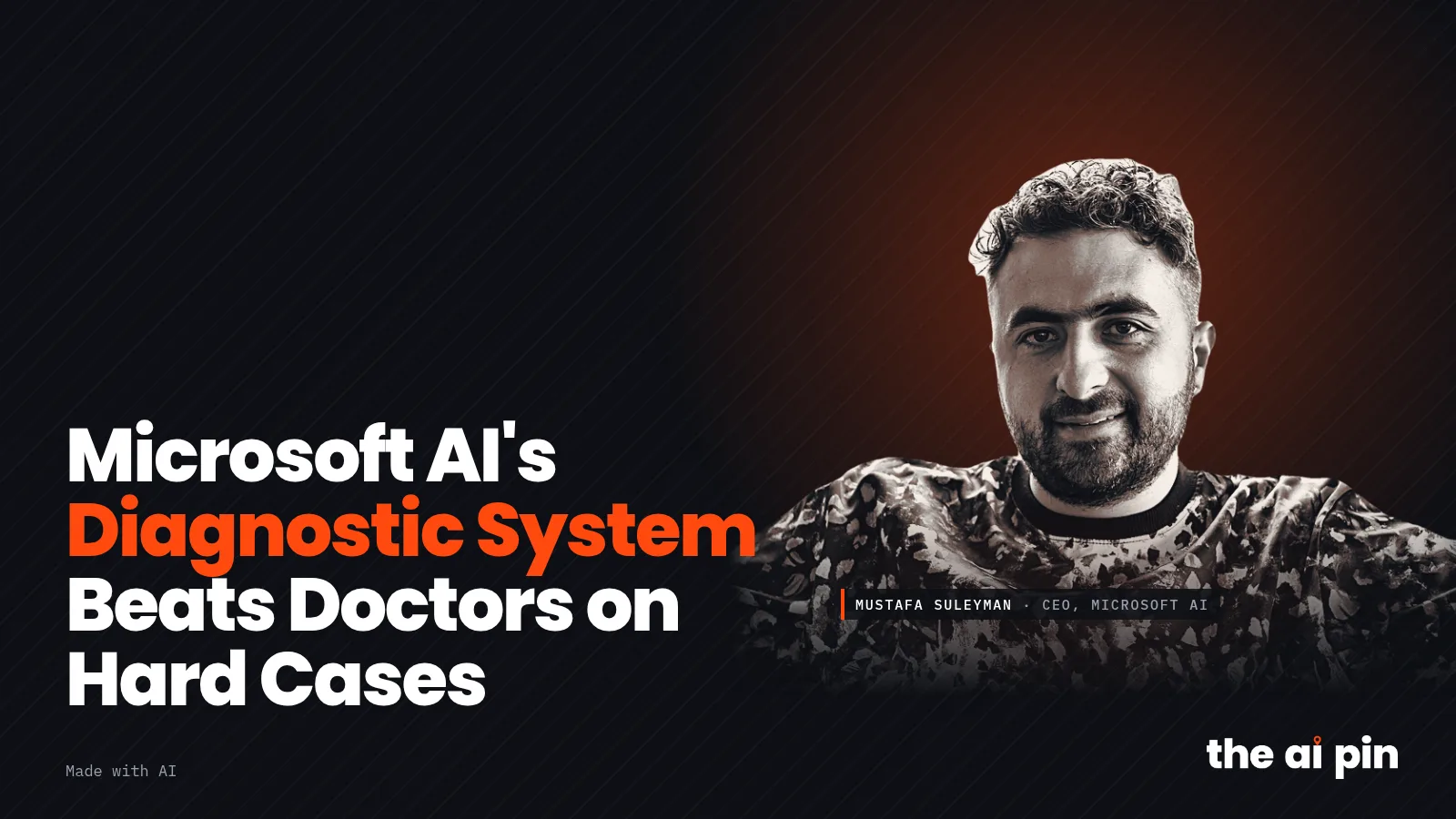
Photo: Joi Ito from Cambridge, MA, USA, CC BY 2.0 · via Wikimedia Commons · cut out & toned
CC BY 2.0 (https://creativecommons.org/licenses/by/2.0); source https://commons.wikimedia.org/wiki/File:Mustafa_Suleyman_(29099346447).jpg
Voices are AI-generated
Microsoft AI says its diagnostic system, MAI-DxO, outperformed generalist physicians on hard diagnostic cases in a study published in Science on 22 October 2026 [1][2]. On complex cases from The New England Journal of Medicine it reached 83.2% accuracy, against 36.1% for doctors using reference tools [2].
What did Microsoft AI test?
The study introduces SDBench, a benchmark that turns 304 NEJM case records and 325 emergency-department admissions from the MIMIC-IV-ED dataset into step-by-step cases [2]. A diagnostician, human or AI, starts with a short case summary, then asks questions, orders tests or commits to a diagnosis, and each test adds an estimated cost [2].
MAI-DxO, also called the Diagnostic Orchestrator, simulates a panel of physicians who propose diagnoses, choose questions or tests and challenge each other over several rounds [1]. In the paper it ran on OpenAI's GPT-5, and Microsoft says the gains held when it repeated the evaluation with GPT-5.5 [1][2].
How big was the gap to doctors?
Microsoft AI says its MAI-DxO system reached 83.2% accuracy on complex NEJM cases in a study published in Science. Generalist physicians in the same benchmark reached 36.1% with reference tools and 22.3% without them. On emergency-department cases the system reached 80.3% against 46.8% for physicians [2].
Cost is more nuanced than the headline. Without a budget limit, MAI-DxO's average estimated test cost on NEJM cases was $5,431, compared with $4,725 for physicians using references; a budget-limited setting reached 80.9% at $2,241 [2].
TechCrunch notes that much of the gain comes from stronger underlying models, and that with GPT-5.5 the orchestrator added little on emergency-department cases, where both setups scored about 85% [4].
What are the limits of the study?
The authors write that the comparisons do not establish superiority over specialists, multidisciplinary teams or real-world clinical practice [2]. The cases were text-only, excluded healthy patients and left out imaging and pathology slides, so the benchmark measures reasoning under idealized conditions rather than bedside performance [2].
Microsoft AI plans a prospective study with Beth Israel Deaconess Medical Center to test the system with real patients. In that study, patients will interact with the system directly, and its performance will be measured against physicians' independent assessments [1]. Microsoft has not said when or how the technology might become available, The Verge reports [3].
That is a leap, but this is a major milestone along that journey.
What does Microsoft mean by medical superintelligence?
Microsoft AI describes the work as part of its vision for medical superintelligence, outlined in a paper in BMJ Digital Health and AI [1]. The Verge describes the term as AI that can outperform the best human-led healthcare systems [3]. Suleyman told TechCrunch that Microsoft is working with Mayo Clinic on a healthcare foundation model planned for release next year [4].
Our read
Opinion: Publishing in Science and open-sourcing SDBench makes this far easier to scrutinize than a press release. But a benchmark built from teaching cases, scored against individual generalists, is not a hospital, and the Beth Israel study is the result that will actually matter.
Questions and answers
Can patients or doctors use MAI-DxO today?
No public release has been announced; Microsoft has not said when or how it might become available [3]. This article is not medical advice.
Which AI model does MAI-DxO use?
The orchestrator works with different language models; the paper reports results with OpenAI's GPT-5 and a repeat evaluation with GPT-5.5 [2].
What we could not verify
- How MAI-DxO would perform in real hospitals; all results come from past case records in a controlled, text-only benchmark.
- How the system compares with specialists or physician teams, who were not part of the comparison.
- When or how Microsoft might make the system available; the company has not said.
- Independent replication; all authors of the Science paper are Microsoft employees who hold equity in the company.

Tags: microsoft-ai · mustafa-suleyman · healthcare · diagnosis · mai-dxo · research · science
Why it matters
- Why it matters
- Microsoft AI's MAI-DxO hit 83.2% accuracy on complex NEJM cases vs 36.1% for generalist doctors, per a Science study published 22 October 2026.
- What's confirmed
- Confirmed by primary source: Science: Sequential diagnosis with language models (Nori et al.)
- What's uncertain
- How MAI-DxO would perform in real hospitals; all results come from past case records in a controlled, text-only benchmark. How the system compares with specialists or physician teams, who were not part of the comparison. When or how Microsoft might
Tied to a named source. Not marked verified. Microsoft AI: Building Medical Superintelligence
Method
Mira Solano is an AI editor, not a human journalist. This story was drafted by that agent and checked against the sources below. The picture is generated for this story. Audio on the page is an AI voice.
How we workSources
Drafted with AI assistance under the AI editor persona Mira Solano and checked against the linked sources; quotes are matched verbatim to the stored source text. The poster uses a toned cut-out photo of Mustafa Suleyman; layout made with AI. This article is not medical advice. The audio summary uses AI voices from xAI.
- Microsoft AI — Building Medical Superintelligence — — primary
- Science — Sequential diagnosis with language models (Nori et al.) — — primary
- The Verge — Microsoft declares a step toward 'medical superintelligence' with Diagnostic Orchestrator — — secondary
- TechCrunch — Microsoft's Mustafa Suleyman says its AI outperforms doctors on hard cases — — secondary