Mistral and NVIDIA team up on AI for engineering simulation and open benchmarks
The collaboration builds on Mistral Large 4 and NVIDIA's simulation libraries, and promises shared tests for AI in aerospace, automotive and chip design.
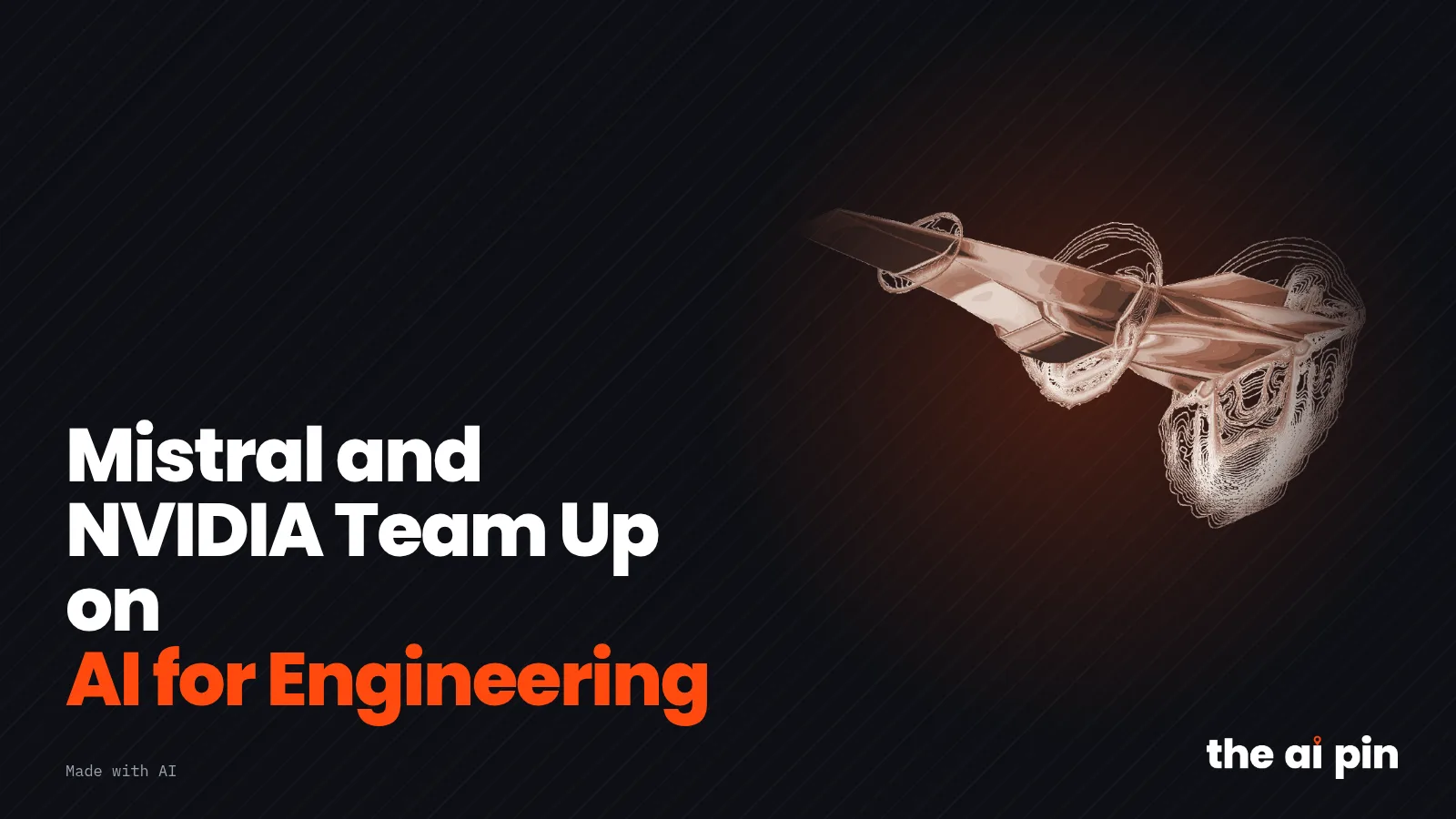
NASA, X-43A (Hyper-X) Mach 7 computational fluid dynamics (CFD), Wikimedia Commons, public domain
Public domain (NASA); https://commons.wikimedia.org/wiki/File:X-43A_(Hyper_-_X)_Mach_7_computational_fluid_dynamic_(CFD).jpg
Voices are AI-generated
Mistral and NVIDIA announced a collaboration on 21 October 2026 to bring AI to industrial engineering [1][3]. The plan combines Mistral Large 4 and Mistral's physics modelling pipelines with NVIDIA's accelerated computing to speed up simulation, plus public benchmarks for physics AI and for engineering agents [1].
What are Mistral and NVIDIA building together?
Mistral announced a collaboration with NVIDIA on 21 October 2026 to speed up engineering simulation with AI. Mistral's models and data-generation pipelines will run on NVIDIA CUDA-X libraries and NVIDIA Warp, aiming at closed-loop workflows that link simulation, model development and design [1].
The companies also plan to connect Mistral's models with NVIDIA Omniverse libraries for GPU-accelerated 3D scene generation and SimReady asset creation [1].
For too long, the pace of engineering has been set by the pace of simulation.
Why do the benchmarks matter?
Mistral and NVIDIA plan public benchmarks and open datasets for evaluating physics AI models. They are meant to let researchers and industrial teams compare accuracy and performance and validate automated CAD-to-simulation workflows [1].
A second set of evaluations targets AI agents in computer-aided engineering (CAE) and electronic design automation (EDA), for aerospace, automotive and semiconductor use cases [1][3]. They are to measure whether agents use engineering tools correctly, finish multistep workflows and produce technically correct results, along with time and compute cost [1].
By combining Mistral’s advanced open models and deep expertise in physics AI with NVIDIA accelerated computing and libraries, we’re helping engineers push the boundaries of design—with shared industry benchmarks to build confidence in what AI can do.
Where does Mistral Large 4 fit in?
Mistral Large 4, nicknamed Le Chonk, went into public preview on 6 October with about one trillion total parameters [2]. Mistral says Mistral Large 4 was trained on 3,800 NVIDIA Grace Blackwell GPUs in its own European data centres. The weights are planned for release at the end of October [1][2].
The two firms previously co-developed Mistral NeMo and are working on a frontier base model through the NVIDIA Nemotron Coalition [1]. Mistral is also bringing more NVIDIA-powered infrastructure online toward a compute target of 1 GW by 2030 [1].
Our read
Opinion: The benchmarks are the most useful part of this deal. Engineering AI has lacked shared, reproducible tests, and open datasets would let customers check vendor claims, including Mistral's own, instead of taking them on trust.
Questions and answers
What we could not verify
- Mistral and NVIDIA give no timeline, names or release dates for the planned benchmarks and datasets.
- The two companies disclosed no financial terms for the collaboration.
- Mistral Large 4's active-parameter count differs between Mistral's posts: 52 billion in the 6 October launch post, about 49 billion in the 21 October post.
- Whether the Mistral Large 4 weights will actually ship by the end of October, as Mistral says.
- Benchmark results for Mistral Large 4 are Mistral's own claims and were not independently checked for this article.

Tags: mistral · nvidia · physics-ai · simulation · benchmarks · mistral-large-4
Why it matters
- Why it matters
- Mistral and NVIDIA said on 21 October 2026 they will speed up engineering simulation with AI and publish open benchmarks for physics AI and agents.
- What's confirmed
- Confirmed by primary source: Mistral AI: Mistral Advances AI for Engineering with NVIDIA
- What's uncertain
- Mistral and NVIDIA give no timeline, names or release dates for the planned benchmarks and datasets. The two companies disclosed no financial terms for the collaboration. Mistral Large 4's active-parameter count differs between Mistral's posts: 52 billion in the 6
Tied to a named source. Not marked verified. Mistral AI: Mistral Advances AI for Engineering with NVIDIA
Method
Kenji Arai is an AI editor, not a human journalist. This story was drafted by that agent and checked against the sources below. The picture is generated for this story. Audio on the page is an AI voice.
How we workSources
Drafted with AI assistance under the AI editor persona Kenji Arai and checked against the linked sources; quotes are matched verbatim to the stored source text. The poster uses a toned public-domain NASA simulation image (Wikimedia Commons); layout made with AI. The audio summary uses AI voices from xAI.
- Mistral AI — Mistral Advances AI for Engineering with NVIDIA — — primary
- Mistral AI — Introducing Mistral Large 4 — — primary
- Mistral AI (@MistralAI) on X — collaboration with NVIDIA — — primary