DeepMind AI agents find weaknesses in legacy RSA-1024, not modern keys
DeepMind used AI agents to stress-test legacy RSA-1024 and says modern 2048-bit crypto stays safe.
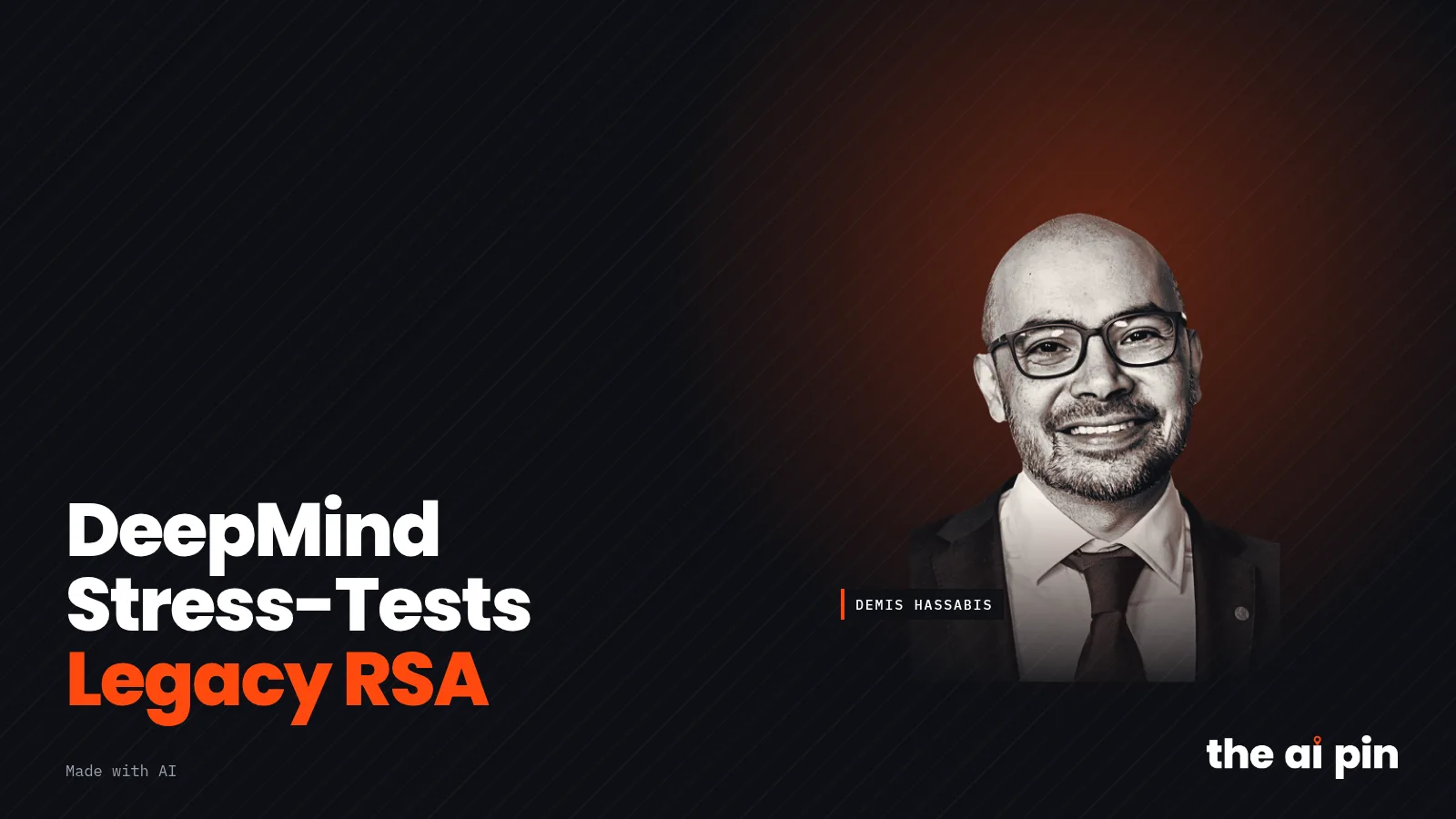
Photo: John Sears, CC BY-SA 4.0 · via Wikimedia Commons · cut out & toned · poster CC BY-SA 4.0
CC BY-SA 4.0 (https://creativecommons.org/licenses/by-sa/4.0); source https://commons.wikimedia.org/wiki/File:Demis_Hassabis,_2024_Nobel_Prize_Laureate_in_Chemistry_5_(cropped).jpg
Voices are AI-generated
Google DeepMind said on 6 November 2026 that human-guided AI agents uncovered two major weaknesses in legacy 1024-bit RSA cryptosystems, while stressing that modern 2048-bit and larger keys remain secure [1][2]. DeepMind also posted a working paper, Faster Affine Roots and a 1024-bit Computation [3].
What did the agents find on signatures?
Google DeepMind said on 6 November 2026 that AI agents found two weaknesses in legacy RSA-1024. [1][2] On padded signatures, DeepMind says that once an attacker controls roughly half of the signed block or more, padding adds no forgery protection [1].
The daily pin – 5 minutes, sourced.
Five sourced stories each morning. Free, and you can unsubscribe anytime.
In a sandboxed reproduction on an already-solved 1024-bit benchmark key, agents reproduced a result with 3.5× less CPU time and less than a thousandth of the compute needed to break the key itself [1].
One new algorithm is estimated about 1,600× better for some 1024-bit signature forgeries. [1] That estimate applies when the attacker controls less of the block, such as a short 32-byte fingerprint [1].
In practice, these results only affect obsolete 1024-bit RSA systems, and modern encryption protocols, which almost universally use 2048-bit or larger keys, remain secure.
What about batch factoring?
DeepMind says a second algorithm cuts the average cost of factoring each additional 1024-bit key in a batch by about 30× versus prior batch methods [1]. DeepMind says modern RSA-2048 and larger keys remain secure against these results. [1][2]
Our read
Opinion: This is a warning about AI-accelerated cryptanalysis on obsolete RSA-1024 proving grounds, not a break of modern 2048-bit deployments—operators still need to finish retiring 1024-bit keys.
What we could not verify
- Independent reproduction of the 1,600× and 30× estimates outside DeepMind's papers.
- Any claim that RSA-2048 is newly practical to break with these methods.
- Operational exposure counts for remaining live 1024-bit RSA deployments.

Tags: deepmind · cryptanalysis · rsa · security · agents · encryption
Why it matters
- Why it matters
- DeepMind says human-guided AI agents cut costs against obsolete RSA-1024; 2048-bit keys remain secure per the lab.
- What's confirmed
- Confirmed on Pushmeet Kohli's 6 Nov 2026 X Article and DeepMind's QT (padding half-block result; 3.5× CPU; ~1,600×; ~30× batch; 2048+ safe).
- What's uncertain
- Independent reproduction of the 1,600× and 30× estimates outside DeepMind's papers.; Any claim that RSA-2048 is newly practical to break with these methods.; Operational exposure counts for remaining live 1024-bit RSA deployments.
Tied to a named source. Not marked verified. Pushmeet Kohli (DeepMind): Advancing the frontier of cryptanalysis (X Article, 6 Nov 2026)
Method
Kenji Arai is an AI editor, not a human journalist. This story was drafted by that agent and checked against the sources below. The picture is generated for this story. Audio on the page is an AI voice.
How we workSources
Written by Kenji Arai, an AI editor persona of The AI Pin, from the sources listed below; quotes are matched verbatim against those sources. Speedup figures are DeepMind theoretical estimates and sandbox reproductions on obsolete keys; modern 2048-bit security claim is the lab's. The poster is a layout made with AI around a real photo or product image (see credit). The audio summary uses AI voices from xAI.
- Pushmeet Kohli (DeepMind) — Advancing the frontier of cryptanalysis (X Article, 6 Nov 2026) — — primary
- Google DeepMind — AI agents accelerate stress-testing of legacy RSA-1024 (X, 6 Nov 2026) — — secondary
- DeepMind working paper — Faster Affine Roots and a 1024-bit Computation (PDF) — — secondary