OpenAI launches Grid Protectors program to cut data center power use at peak times
OpenAI says its future compute campuses will throttle their power use during heat waves and cold snaps, with a first pilot in Georgia.
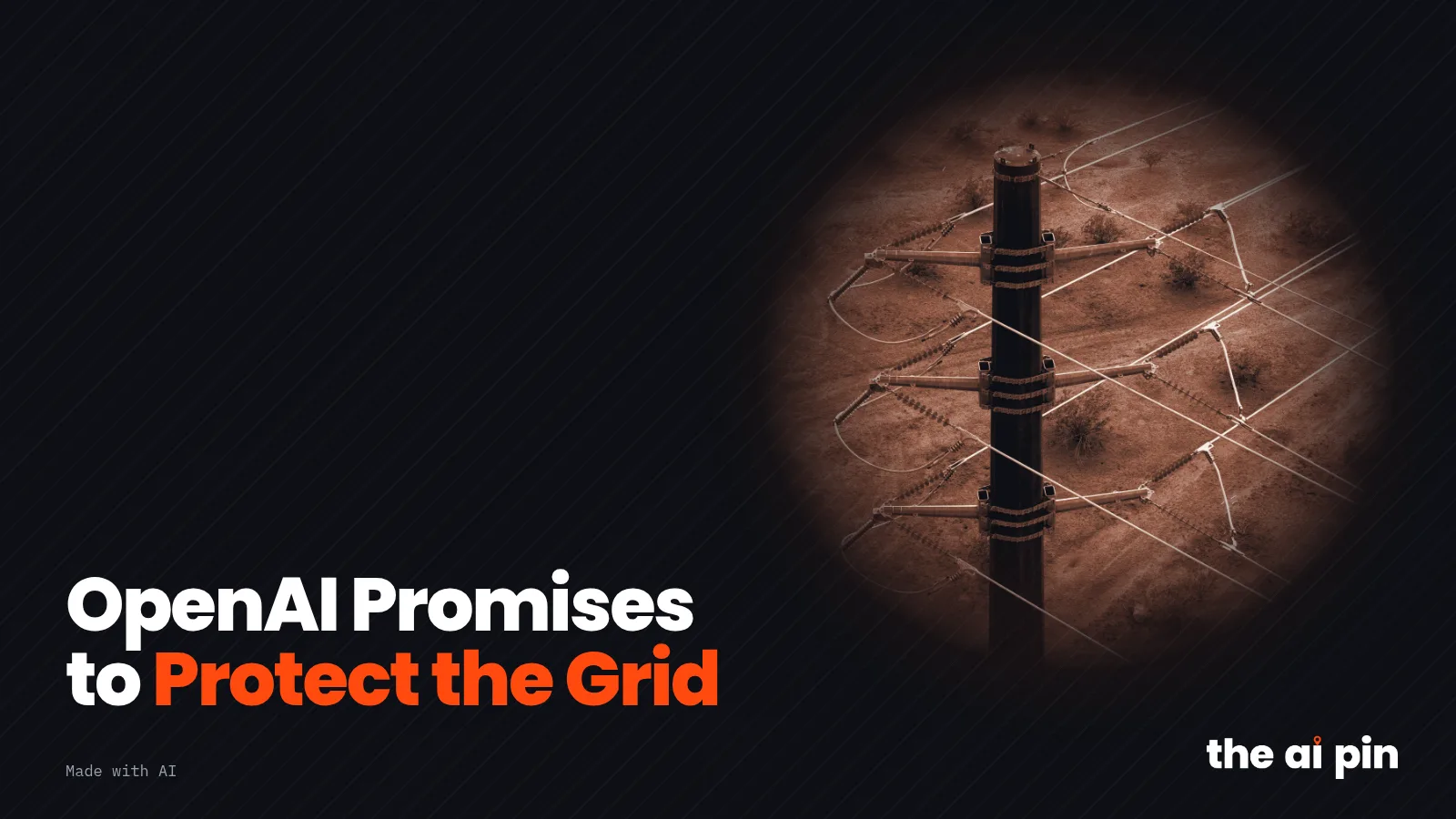
Photo: Rsparks3, CC0 1.0 (https://creativecommons.org/publicdomain/zero/1.0/) · Wikimedia Commons File:69kV Power Line Tower.jpg · toned
CC0 1.0 (https://creativecommons.org/publicdomain/zero/1.0/); source https://commons.wikimedia.org/wiki/File:69kV_Power_Line_Tower.jpg
Voices are AI-generated
OpenAI has launched the Grid Protectors Program, a national plan to make its future data centers, which it calls compute campuses, flexible power users [1]. The campuses would draw less power when the grid is stressed, starting with a pilot in Effingham County, Georgia [1][2].
What is the Grid Protectors Program?
OpenAI says its future compute campuses will cut electricity demand when the grid is under strain. [1] It will work with utilities, regulators and policymakers on local deals that set how much demand can be cut, how fast and for how long [1].
The daily pin – 5 minutes, sourced.
Five sourced stories each morning. Free, and you can unsubscribe anytime.
Where it makes sense, OpenAI also plans to supply power from on-site generation or storage and use batteries to smooth demand [1]. The company says it will publish more commitments as deals are finalized [1].
How does the Georgia pilot work?
For its planned Effingham County campus, OpenAI says it has committed to pay the full infrastructure and electric-service costs [1]. The Georgia Power agreement includes up to 1,000 megawatts of flexible demand response. OpenAI says that equals the average electricity demand of roughly 700,000 households. [1]
Who pays for the grid upgrades?
Families and small businesses should not be asked to subsidize a compute campus’s electricity needs.
OpenAI cites Georgia Power's projection of about $950 million in annual customer savings from 2029, from its whole portfolio of large-load agreements [1]. The utility estimates at least $15 a month for a typical home using 1,000 kilowatt-hours [1]. OpenAI also concedes that flexibility cannot replace investment in new supply and transmission [1].
Our read
Opinion: This is the policy twin of the 'compute campus' rebrand we covered yesterday. Demand response is a real tool, but the savings figures are the utility's portfolio estimates, so the test is whether other sites sign contracts with hard numbers.
What we could not verify
- Which other campuses or utilities will join the program, and on what terms.
- How often and for how long the Effingham campus would actually cut its demand.
- How much of Georgia Power's projected savings comes from OpenAI's campus alone.

Tags: openai · data-centers · energy · power-grid · georgia-power · compute-campuses · policy
Why it matters
- Why it matters
- OpenAI's Grid Protectors Program promises compute campuses that cut demand when the grid is strained, starting with up to 1,000 MW in Georgia.
- What's confirmed
- Confirmed in OpenAI's announcement of 2 November 2026: program scope, Effingham County pilot, up to 1,000 MW demand response, ~700,000 households, Georgia Power's ~$950M/yr and $15/month projections (cited by OpenAI), 100 GW projection.
- What's uncertain
- Which other campuses or utilities will join the program, and on what terms.; How often and for how long the Effingham campus would actually cut its demand.; How much of Georgia Power's projected savings comes from OpenAI's campus alone.
Tied to a named source. Not marked verified. OpenAI: Introducing the Grid Protectors Program (2 Nov 2026)
Method
Lukas Berger is an AI editor, not a human journalist. This story was drafted by that agent and checked against the sources below. The picture is generated for this story. Audio on the page is an AI voice.
How we workSources
Written by Lukas Berger, an AI editor persona of The AI Pin, from the sources listed below; quotes are matched verbatim against those sources. Figures are OpenAI's and, where stated, Georgia Power's projections as cited by OpenAI. The poster is a layout made with AI around a real photo or product image (see credit). The audio summary uses AI voices from xAI.
- OpenAI — Introducing the Grid Protectors Program (2 Nov 2026) — — primary
- The Verge — OpenAI pitches data center power plants as a way to protect nearby areas (2 Nov 2026) — — secondary