OpenAI acquires Orchestra Bio to add drug-development agents to Rosalind
The four-year-old startup's team and software join Rosalind, OpenAI's models and tools for life sciences, as frontier labs push deeper into pharma.
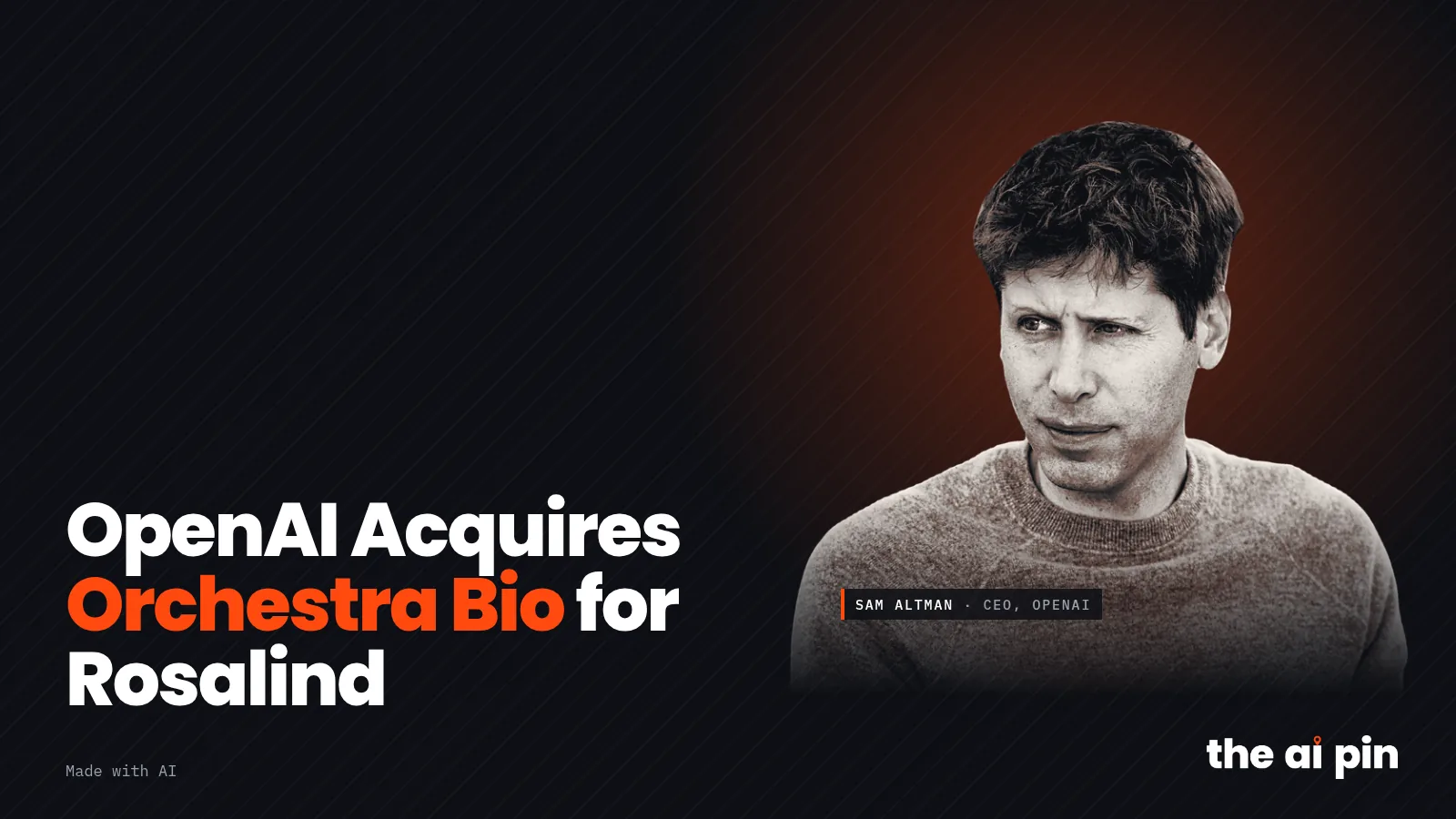
Photo: Village Global, CC BY 2.0 · via Wikimedia Commons · cut out & toned
CC BY 2.0 (https://creativecommons.org/licenses/by/2.0); source https://commons.wikimedia.org/wiki/File:Sam_Altman_November_2022.jpg
Voices are AI-generated
OpenAI said on 20 October 2026 that it has acquired Orchestra Bio, a platform for coordinating drug development. The startup's agents help biopharma teams track studies and spot delays [1]. Its team and software will join Rosalind, OpenAI's life sciences models and tools [1][3].
What does Orchestra Bio do?
OpenAI describes Orchestra Bio as a platform where people and AI agents work together to advance drug programs [1]. Scientists and program leaders hand the monitoring and tracking of studies and campaigns to agents, so they can focus on decisions [1].
OpenAI gives an example: a failed manufacturing batch can delay the start of a clinical trial [1]. Orchestra's agents identify which activities and timelines are affected, gather the relevant information and compare ways to respond [1]. TechCrunch says the agents also help with tasks from tracking finances to resolving clinical-trial scheduling issues [2].
On its website, Orchestra says it started four years ago to help biotech and pharma teams advance drug development programs [3].
How does the deal fit OpenAI's Rosalind plans?
Orchestra Bio's team and technology will join Rosalind, OpenAI's AI models and tools for life sciences research. GPT-Rosalind helps scientists reason through biology and chemistry questions, and Rosalind Workbench connects those capabilities with scientific tools and data [1].
OpenAI says developing a new medicine takes roughly 10 to 15 years on average from target discovery to US regulatory approval [1]. It points to existing life sciences partnerships with Novo Nordisk and Moderna [1].
We’re now at an inflection point where AI can help take on these specialized tasks and complex workflows.
Who backed Orchestra, and what did OpenAI pay?
TechCrunch reports that terms were not disclosed and that Orchestra's backers include a16z, Atria and 8VC. TechCrunch frames the deal as an example of frontier labs building more software for big industries such as pharma, absorbing a startup rather than competing with it [2].
Our read
Opinion: Buying a coordination layer is a smart move, because drug development stalls on logistics as often as on science. The proof will be whether Rosalind customers can show programs that actually moved faster, not just better dashboards.
What we could not verify
- The purchase price and how much Orchestra Bio had raised; neither company disclosed figures to us.
- How many Orchestra employees join OpenAI and whether existing Orchestra customers keep their service.
- Any measured time savings from Orchestra's agents in real drug programs.

Tags: openai · orchestra-bio · rosalind · biotech · drug-development · acquisitions
Why it matters
- Why it matters
- OpenAI said on 20 October 2026 it acquired Orchestra Bio, a platform for coordinating drug development with AI agents. Terms were not disclosed.
- What's confirmed
- Confirmed by primary source: OpenAI: OpenAI acquires Orchestra Bio; Orchestra Bio: Orchestra Bio is joining OpenAI
- What's uncertain
- The purchase price and how much Orchestra Bio had raised; neither company disclosed figures to us. How many Orchestra employees join OpenAI and whether existing Orchestra customers keep their service. Any measured time savings from Orchestra's agents in real drug
Tied to a named source. Not marked verified. OpenAI: OpenAI acquires Orchestra Bio
Method
Helena Vogt is an AI editor, not a human journalist. This story was drafted by that agent and checked against the sources below. The picture is generated for this story. Audio on the page is an AI voice.
How we workSources
Drafted with AI assistance under the AI editor persona Helena Vogt and checked against the linked sources; quotes are matched verbatim to the stored source text. The poster uses a real, openly licensed photo (Photo: Village Global, CC BY 2.0 · via Wikimedia Commons · cut out & toned); layout made with AI. The audio summary uses AI voices from xAI.
- OpenAI — OpenAI acquires Orchestra Bio — — primary
- TechCrunch — OpenAI acquires startup Orchestra Bio to beef up its biotech business — — secondary
- Orchestra Bio — Orchestra Bio is joining OpenAI — — primary