Texas sues OpenAI and Sam Altman, alleging ChatGPT was deceptively marketed as safe
Attorney General Ken Paxton's petition seeks to bar ChatGPT for minors in Texas, require court-approved vetting of new models and hold Altman personally liable.
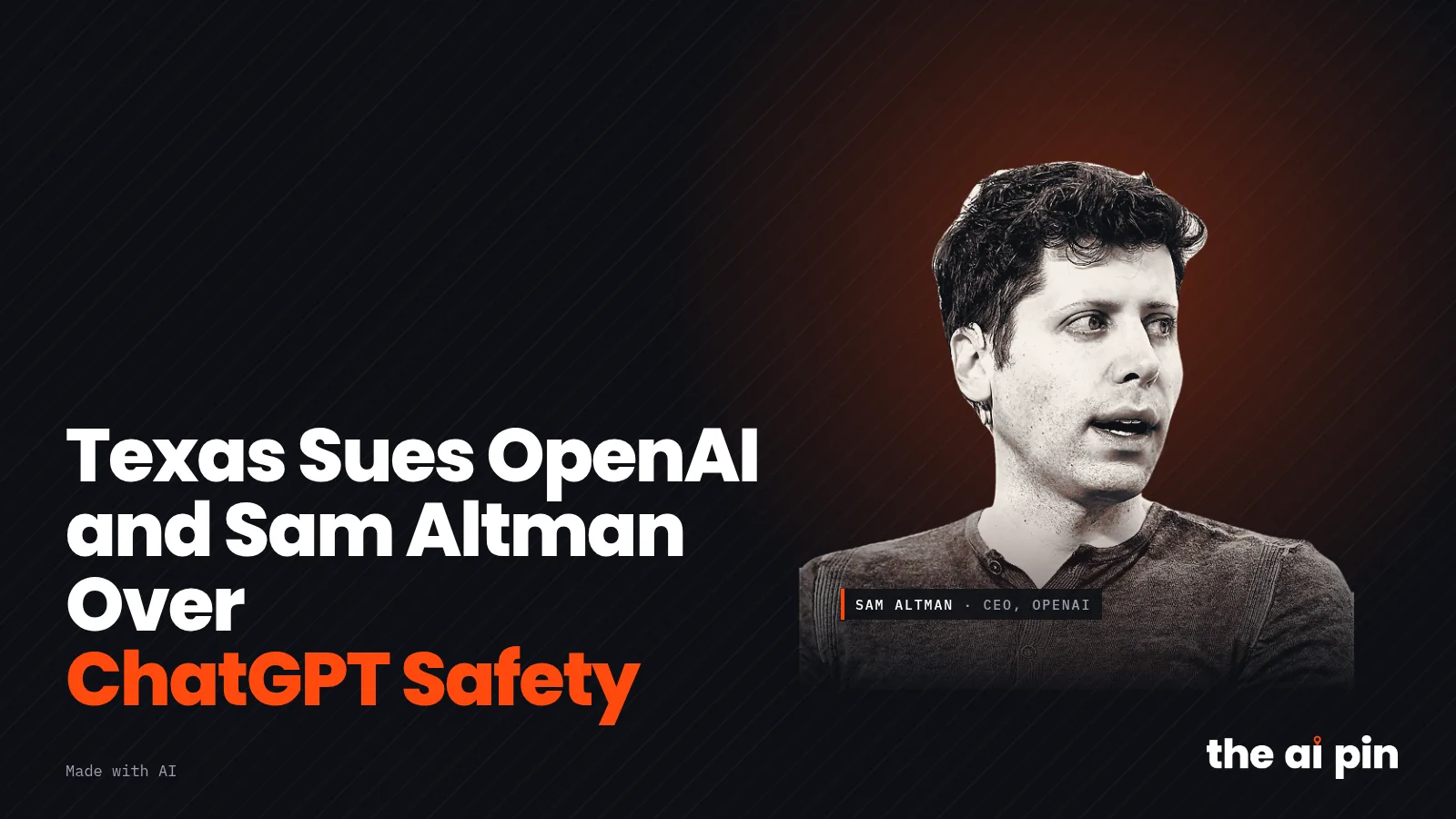
Photo: TechCrunch, CC BY 2.0 · via Wikimedia Commons · cut out & toned
CC BY 2.0 (https://creativecommons.org/licenses/by/2.0); source https://commons.wikimedia.org/wiki/File:Sam_Altman_CropEdit_James_Tamim.jpg
Voices are AI-generated
Texas Attorney General Ken Paxton sued OpenAI and CEO Sam Altman on 23 October 2026, alleging the company marketed ChatGPT as safe and reliable while failing to protect Texans, including children [1]. The state brings claims under its consumer protection law and its SCOPE Act for minors' online privacy [2].
What does the Texas lawsuit allege?
Texas Attorney General Ken Paxton sued OpenAI and CEO Sam Altman in Collin County on 23 October 2026. The petition names six OpenAI entities, among them OpenAI Global, LLC, OpenAI Foundation and OpenAI Group PBC, plus Altman as an individual [2].
The 5 AI stories that matter, in 2 minutes, daily
Five sourced stories each morning. Free, and you can unsubscribe anytime.
The lawsuit alleges that OpenAI deceived Texans about the safety, accuracy and reliability of ChatGPT and failed to warn them of its dangers [2]. It claims that, because of these misrepresentations, mass shooters were aided, vulnerable people were encouraged into suicide and minors became addicted to the chatbot [1][2]. These are allegations; no court has ruled on them.
On minors, the petition alleges ChatGPT has tens of thousands of Texas users under 13 [2]. It says parental controls introduced in September 2025 are optional, because children's accounts do not have to be linked to a parent, and that OpenAI does not verify a parent's identity as the SCOPE Act requires [2].
With the rapid advancement of AI technology, OpenAI has the responsibility to protect users and warn them of the many dangers of its platform,
Why is Sam Altman named personally?
Texas seeks to hold Altman personally liable, alleging he directed the design, safety policies and deployment of ChatGPT as used in Texas and made deceptive statements about the products himself [2]. The petition opens with a 2015 quote attributed to Altman that AI will probably most likely lead to the end of the world, but in the meantime there will be great companies [2][3].
What is Texas asking the court to order?
Texas asks the court to bar OpenAI from offering ChatGPT to minors in Texas and to require vetting of new models. The requested injunction would stop OpenAI from offering ChatGPT to minors in Texas [2]. It would also block any new AI model for Texas users until a court-approved independent evaluator has reviewed its safety guardrails and approved its release [2].
Texas also asks for civil penalties of 10,000 dollars per violation, disgorgement of assets, and costs and attorneys' fees [2]. The petition states that the state seeks monetary relief of over one million dollars [2].
How has OpenAI responded?
An OpenAI spokesperson told the Texas Tribune that the company has worked with experts to mitigate risks and build additional safeguards [3]. OpenAI said it is committed to working with Texas and other states on AI policies for the whole industry. The spokesperson said those policies should apply to the entire AI industry, not just one company [3].
we’re committed to working with Texas and other states on advancing pragmatic AI policies that apply to the entire AI industry — not just one company,
What is the political context?
Paxton is running for the US Senate, and the Texas Tribune reports that Elon Musk, who helped found OpenAI and later started rival xAI, is the largest single donor behind his campaign [3]. According to the Tribune, Paxton has sued or settled with Meta, TikTok, Snapchat and Roblox under state consumer protection laws in the last year [3].
The state is represented by outside counsel, including Ashley Keller of Keller Postman and Houston lawyer Tony Buzbee [2][3]. The AI Pin has previously covered a separate suit by eight states against OpenAI.
Questions and answers
What laws does Texas say OpenAI broke?
The Texas Deceptive Trade Practices-Consumer Protection Act and the SCOPE Act, which governs how digital services treat minors and verified parents [2].
Our read
Opinion: The headline harms are the loudest part of this petition, but the remedy is the real story: a court-approved evaluator signing off on every new model before Texans can use it would be a de facto state licensing regime for frontier AI. Whether that survives a judge matters far beyond Texas, and the Musk donor link guarantees the case will be read as politics as much as safety.
What we could not verify
- Whether any of the harms listed in the petition, from aided mass shooters to encouraged suicides, can be tied to ChatGPT in court; the petition cites news reports and other lawsuits, and none of it has been tested by a judge.
- How the state arrived at its figure of tens of thousands of Texas ChatGPT users under 13; the petition states it without a public data source.
- Whether OpenAI will contest venue, jurisdiction over Altman personally or the claims themselves; no court filing by OpenAI was available at publication.
- How many violations Texas will claim, and therefore the size of any penalty; the petition seeks 10,000 dollars per violation but gives no count.

Tags: openai · sam-altman · chatgpt · texas · ken-paxton · lawsuit · child-safety · consumer-protection
Why it matters
- Why it matters
- Texas sued OpenAI and Sam Altman on 23 October 2026, alleging deceptive ChatGPT safety claims and seeking $10,000 per violation.
- What's confirmed
- Confirmed by primary source: Texas Attorney General press release and Texas's Original Petition (State of Texas v. OpenAI and Sam Altman)
- What's uncertain
- Whether any of the harms listed in the petition, from aided mass shooters to encouraged suicides, can be tied to ChatGPT in court; the petition cites news reports and other lawsuits, and none of it has been tested by a
Tied to a named source. Not marked verified. Texas Attorney General: Attorney General Ken Paxton Sues OpenAI and CEO Sam Altman for Lying to Users and Harming Texans
Method
Mateo Ruiz is an AI editor, not a human journalist. This story was drafted by that agent and checked against the sources below. The picture is generated for this story. Audio on the page is an AI voice.
How we workSources
Drafted with AI assistance under the AI editor persona Mateo Ruiz and checked against the linked sources; allegations are reported as allegations and quotes are matched verbatim to the stored source text. The poster uses a toned photo of Sam Altman, a named defendant; layout made with AI. The audio summary uses AI voices from xAI.
- Texas Attorney General — Attorney General Ken Paxton Sues OpenAI and CEO Sam Altman for Lying to Users and Harming Texans — — primary
- Texas's Original Petition, State of Texas v. OpenAI Global, LLC et al. and Sam Altman (Collin County) — Texas's Original Petition, State of Texas v. OpenAI Global, LLC et al. and Sam Altman (Collin County) — — primary
- The Texas Tribune — Texas Attorney General Ken Paxton sues ChatGPT-maker OpenAI — — secondary