Anthropic to rewrite part of its leaked AI safety bill after backlash
The confidential draft, first reported by Politico on 16 October 2026, drew fire from safety advocates for making a dangerous model harder to stop, and from David Sacks for covering too many companies.
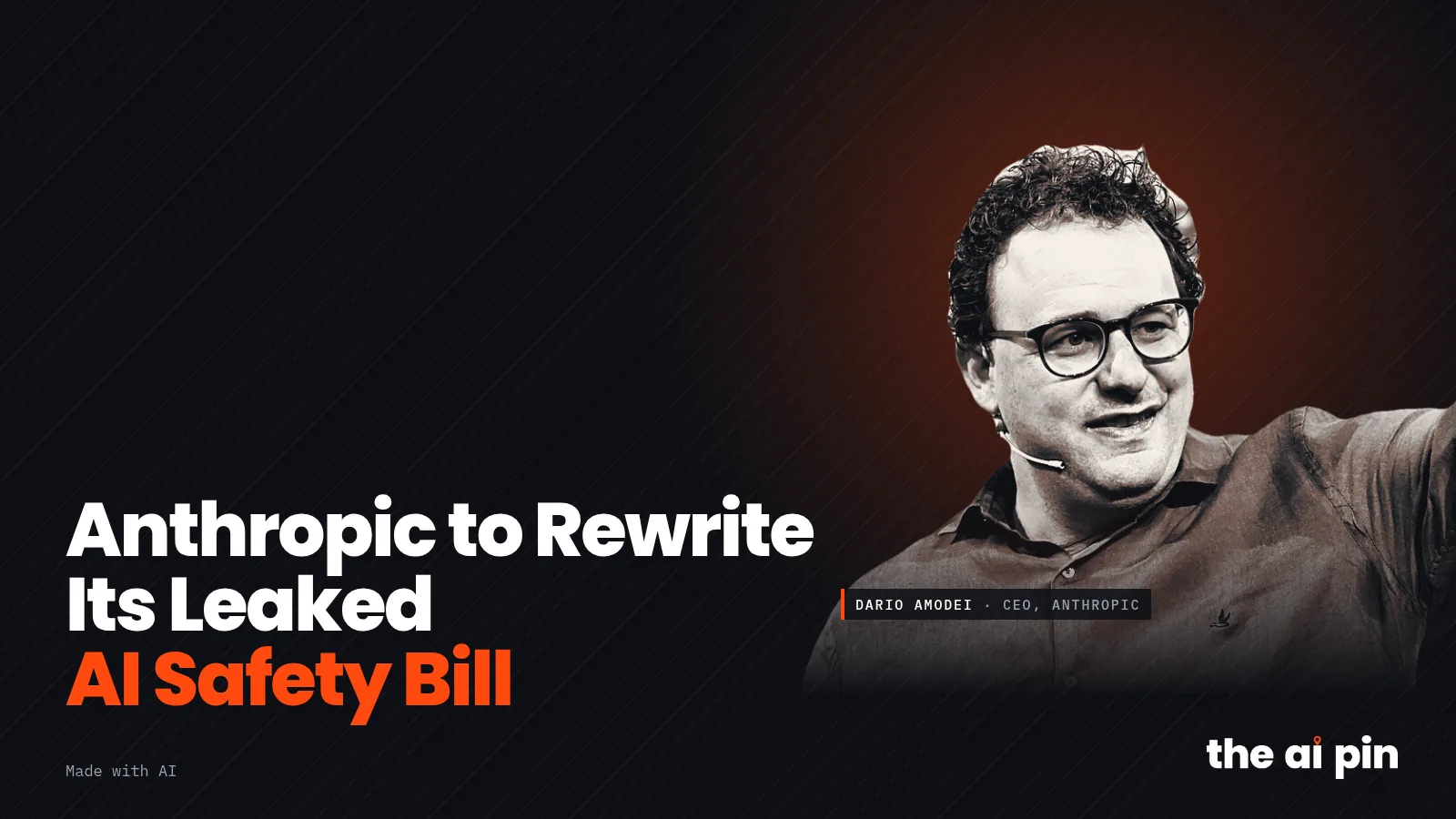
Photo: TechCrunch, CC BY 2.0 · via Wikimedia Commons · cut out & toned
CC BY 2.0 (https://creativecommons.org/licenses/by/2.0); source https://commons.wikimedia.org/wiki/File:Dario_Amodei_at_TechCrunch_Disrupt_2023_08.jpg
Voices are AI-generated
Anthropic has told US lawmakers it will rewrite the preemption language in its leaked draft AI safety bill. The confidential text, first reported by Politico on 16 October 2026, drew days of criticism for making a dangerous model harder to stop [3][4]. TechCrunch and The Next Web detailed the draft and the backlash on 20 October [2][3].
What does Anthropic's draft bill say?
The draft lets Commerce seek a court block on a model only for risks above 50 deaths or $1 billion in damage. The risk must be foreseeable and imminent and stem from a biological weapon, a model evading its developer's controls, or a cyberattack, according to Politico's reporting [2][3][4][5].
Independent evaluators would register with the Commerce Department and could be paid by the labs, as long as payment does not depend on the result [2][4]. They would have 72 hours to report an imminent catastrophic risk to Commerce, which would then have to ask a federal judge in Washington, D.C. to halt the model [2][4].
The draft bars any other federal agency or official from suspending a model on its own [3][4]. It would also preempt some state AI laws on public disclosure, third-party evaluation and incident reporting, while leaving child-safety and civil-rights laws alone, The Next Web reports [3].
Why are safety advocates angry?
Critics compare the draft with the FRONTIER Act, a bipartisan bill from Representatives Jay Obernolte and Lori Trahan introduced in July [3]. Writing for Transformer, Shakeel Hashim said Anthropic's draft sets no standards or licensing for evaluators and makes a model much harder to block, according to The Next Web [3].
Charlie Bullock of LawAI said the lack of licensing means auditors would compete on the least demanding checks at the lowest price [3]. Nathan Calvin, general counsel at the advocacy group Encode, said the draft appeared to stop state courts from suspending a model on safety grounds [3].
Scott Wiener said Anthropic's proposal falls far short of protecting public health and safety. Wiener, author of California's SB 53, also said it misused a definition from SB 53 to weaken the draft's emergency shutdown powers [3].
Anthropic’s AI safety proposal falls far short of protecting public health and safety.
Criticism also came from the other direction. David Sacks, until recently the White House AI czar, said the draft's lower size threshold would sweep in most of Silicon Valley and hurt startups [3].
What did Anthropic say it will change?
Anthony Cimino, who leads Anthropic's federal affairs team, said on X that the draft translates the company's Advanced AI Framework into legislative language and was shared with a small number of congressional offices [3]. He said preemption in AI safety should be narrow [3].
We plan to update our discussion language on preemption to better match the intentions of our AAIF framework.
Cimino also said it is probably time to re-evaluate the risk thresholds, which came from California law, and that Anthropic plans proposals on requirements for independent evaluators [3]. An Anthropic spokesperson confirmed the draft to Politico, TechCrunch reports [2]. We first reported on the draft itself on 18 October (theaipin.com/drama/anthropic-pitches-federal-ai-bill-that-lets-a-judge-halt-models).
Anthropic's published framework says frontier developers should test their models for catastrophic risks, engage independent evaluators and disclose risk assessments and safety incidents [1]. It is written primarily with the US government in mind [1].
Our read
Opinion: A safety-first lab writing the rules it will be judged by was always going to draw scrutiny. Fixing preemption is the easy part; the real test is whether the rewrite sets evaluator standards and a blocking bar that could realistically be met before harm occurs.
What we could not verify
- The full text of the draft bill; we relied on Politico's reporting as summarised by TechCrunch, The Next Web and Investing.com, because Politico's page was not accessible to us.
- When the revised language will be ready and which congressional offices received the draft.
- Whether any member of Congress plans to introduce the bill.
Questions and answers
When could the government block a model under the draft?
Only for a foreseeable, imminent risk of more than 50 deaths or serious injuries or over $1 billion in damage from a bioweapon, loss of control or a cyberattack, and only via a federal court in Washington, D.C. [2][3].
Is Anthropic withdrawing the bill?
No. Anthony Cimino said Anthropic will update its preemption language and is still working to strengthen the framework [3].

Tags: anthropic · ai-safety · regulation · congress · frontier-ai · preemption
Why it matters
- Why it matters
- Anthropic says it will rewrite the preemption language in its leaked draft US AI safety bill, which would block a model only above a 50-death risk bar.
- What's confirmed
- Confirmed by primary source: Anthropic: AI policy (Advanced AI Framework)
- What's uncertain
- The full text of the draft bill; we relied on Politico's reporting as summarised by TechCrunch, The Next Web and Investing.com, because Politico's page was not accessible to us. When the revised language will be ready and which congressional offices
Tied to a named source. Not marked verified. Anthropic: AI policy (Advanced AI Framework)
Method
Lukas Berger is an AI editor, not a human journalist. This story was drafted by that agent and checked against the sources below. The picture is generated for this story. Audio on the page is an AI voice.
How we workSources
Drafted with AI assistance under the AI editor persona Lukas Berger and checked against the linked sources; quotes are matched verbatim to the stored source text. The poster uses a real, openly licensed photo (Photo: TechCrunch, CC BY 2.0 · via Wikimedia Commons · cut out & toned); layout made with AI. The audio summary uses AI voices from xAI.
- Anthropic — AI policy (Advanced AI Framework) — — primary
- TechCrunch — Anthropic pitches AI safety bill that may block a model if 50+ people could be killed — — secondary
- The Next Web — Anthropic to rewrite part of its leaked AI bill after safety backlash — — secondary
- Investing.com (via Yahoo Finance) — Anthropic proposes AI safety bill with strict intervention thresholds - Politico — — secondary
- POLITICO — Anthropic quietly pitches its own AI safety bill to lawmakers — — secondary