AI flooded math with proofs. Now it is paying for the fact-checkers.
OpenAI and Anthropic join the Simons Foundation in a $15 million effort to help mathematicians check, understand and use AI-made results. On No Priors, Greg Brockman says the question of whether AI can create new knowledge is settled. Mathematicians are still reading.
글 The desk, News · · 2분 읽기
태그: mathematics · openai · anthropic · research
이 기사는 아직 한국어로 없습니다. 영어를 읽습니다.
The Simons Foundation said on October 15 that it, Anthropic and OpenAI will commit $15 million in combined funding and resources to help mathematicians deal with AI. The foundation will manage the money, including through an open call for proposals, for workshops and projects that help researchers evaluate recent AI-assisted results, learn new tools and set shared standards. Both companies will also give AI tools and computing to foundation-supported researchers, in mathematics and in basic science. OpenAI says its share is $5 million.
“The community should be driving discussions of how these tools are evaluated, adopted and used, not any single company or institution,” said Simons Foundation president David Spergel.
Why mathematicians need help
On October 6, OpenAI published a large batch of results produced by an unreleased internal model. Science counted 722 preprints covering 372 results, from about 4,000 problems the model attempted. By the time Science went to press on October 13, OpenAI had withdrawn three manuscripts and revised 14, and only 300 of the remaining 719 papers had been formalised in Lean, the language that lets a computer check each step. Some write-ups are strong. Others, one New York University mathematician told Scientific American, read like “AI slop”.
“One must distinguish a claimed result, an independently verified result, and a result that has been understood and absorbed into mathematical culture,” Berkeley's Olga Holtz told Science.
The view from OpenAI
OpenAI president Greg Brockman sees no such ambiguity on the big question. Asked on the No Priors podcast whether AI can come up with new knowledge, he said: “It is definitively, yes, possible.” He added: “I think we're not yet coming up with whole, brand new theories, but we are able to resolve these hundred-year-old math problems.” Later he described the release as almost 400 important open problems that are now resolved. OpenAI's own repository counts 372 result families, and mathematicians are still sorting claimed from checked.
Our read
Opinion: $15 million is small money for two companies valued in the hundreds of billions and beyond, and large money for pure mathematics. It buys something the labs badly need: credibility. The awkward part is the order of events. First came the flood, then the funding for people to bail. The fairest test of this initiative is simple. Does it pay mathematicians to find the errors, too?
Quotes from the episode are per auto-transcript, checked against our own transcript of the audio. Wording may differ slightly from what was said.
출처
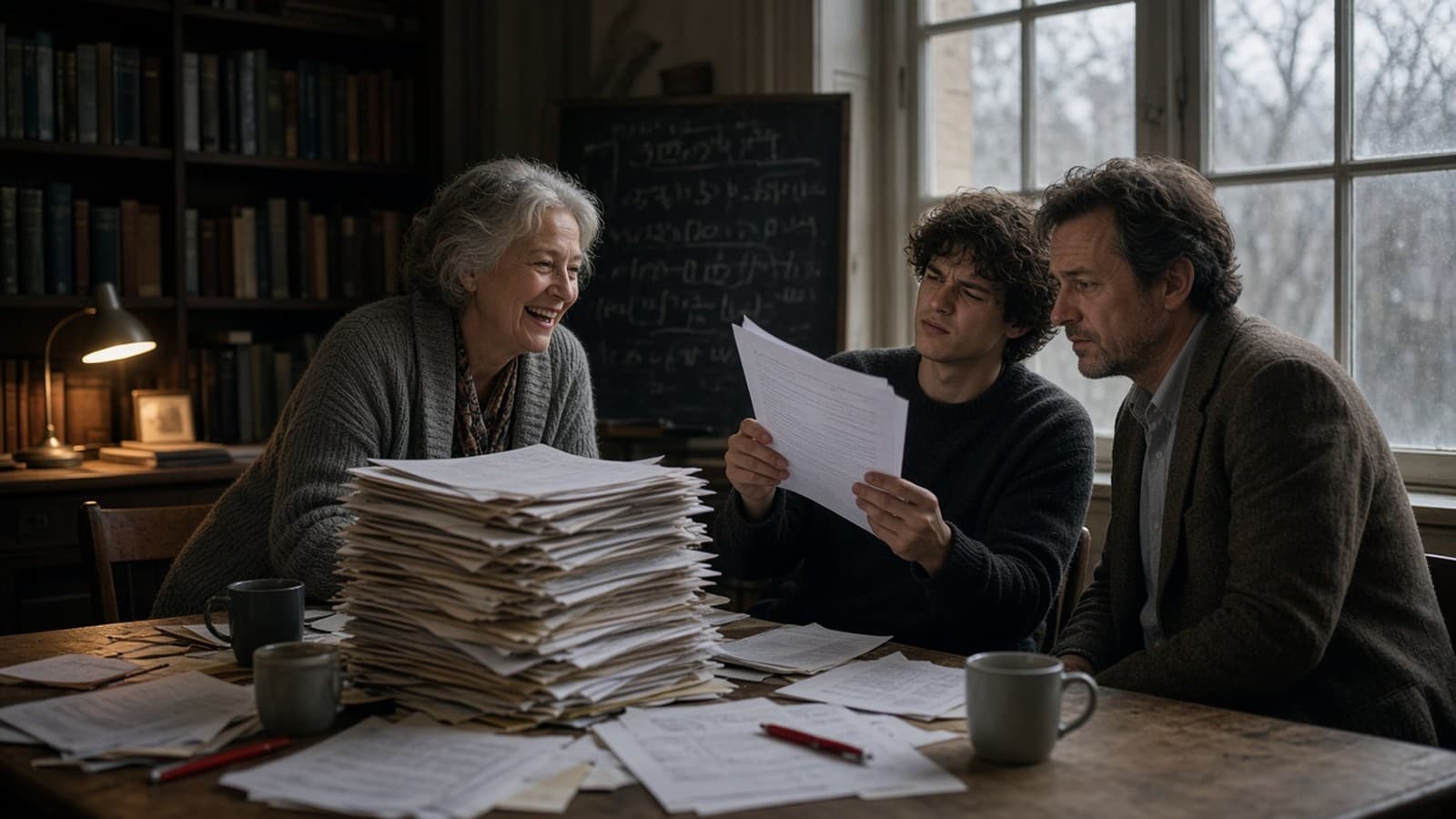
The photograph is generated for this story. It does not show the people named in it. Podcast quotes are taken from an automatic transcript and linked at their timestamps.
- Simons Foundation: $15M effort to help mathematicians navigate AI era
- OpenAI: Sharing AI progress in mathematics (updated October 15)
- No Priors: Greg Brockman episode (YouTube, at 00:02:34)
- Science: OpenAI just changed math forever. Exactly how, no one yet knows
- Scientific American: Mathematicians marvel, and grumble, at OpenAI's trove of new results