Claude traces the mysterious NIST elliptic-curve seeds to 1990s timestamps
The answer to a 25-year-old cryptography riddle turned out to be a clock, and it took the model under half an hour.
The AI Pin
own
Le voci sono generate dall'IA
Questo pezzo non è ancora in Italiano. Stai leggendo l'inglese.
An internal Anthropic research model found in under half an hour that the seeds behind the NIST P-192, P-224, P-256, P-384 and P-521 elliptic curves were not hashes of a phrase but output of the C library's lrand48 random-number generator, seeded with Unix timestamps, Anthropic said on 16 October 2026 [1].
Where did the NIST curve seeds come from?
NIST adopted the curves in 2000 in FIPS 186-2, and the NSA supplied the seeds without explanation [1]. Each seed is hashed to set a curve coefficient, so an unexplained seed left room to suspect a deliberately weakened curve [1][2].
The daily pin – 5 minutes, sourced.
Five sourced stories each morning. Free, and you can unsubscribe anytime.
The long-told story was that NSA employee Jerry Solinas hashed a joke sentence he later forgot. Solinas died in 2023 [1][2]. Anthropic says several employees had chased that lead without success before an employee asked the model without pointing at the clue [1].
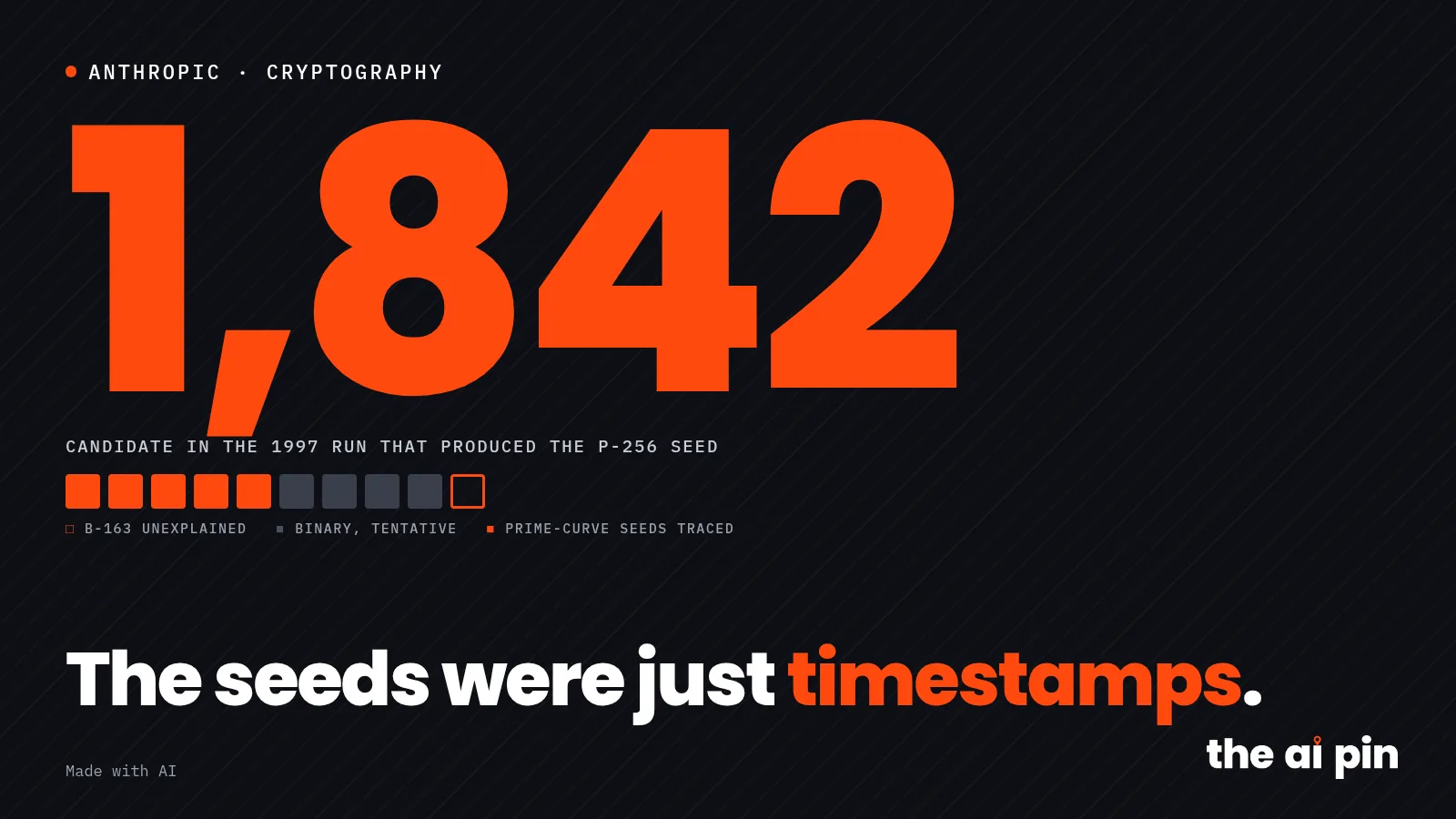
The model found that every initialisation behind the ten prime-curve seeds, five NIST and five from ANSI X9.62, was a timestamp between May 1997 and April 1998 [1]. The P-256 seed is candidate 1,842 of a run started on 16 August 1997 [1].
Recovering the generator's state from truncated output is a textbook lattice problem, solved with LLL basis reduction, Anthropic says [1]. We ran Anthropic's published script and it reproduced the P-256 seed C49D360886E704936A6678E1139D26B7819F7E90.
This is not a cryptographic break, new attack, or weakness in the ECDSA curves.
What is still unexplained?
Four NIST binary-curve seeds fit if the program halved the clock, which Anthropic presents as a tentative reading [1]. The fifth binary seed, B-163, fits nothing the model tried, and the base points for P-224, P-256, P-384 and P-521 remain unexplained [1].
Some viable curves were skipped: for P-256, candidate 876 of the same run would also have worked [1]. Anthropic says it does not know what criteria were used, or whether it was an unintentional artifact [1].
Who gets the bounty?
Cryptographer Filippo Valsorda, who organised the bounty, said the Anthropic team claimed it on 15 October 2026 at 01:07:51 UTC and chose to donate it to ISRG, tripling its value to $36,864 [2]. Valsorda describes the generator as drand48; Anthropic's code reads lrand48 output from the same generator family [1][2].
This helps fill out a page of cryptographic history, and reinforces our confidence in these critical cryptographic primitives.
Our read
Opinion: The most useful AI science result this week is a boring one. A model closed a 25-year trust question with code anyone can rerun, which is the right standard for AI research claims.
What we could not verify
- We reproduced only the P-256 seed; we did not rerun the lattice search or check the binary-curve reading.
- Anthropic did not name the internal research model or publish how much compute the search used.
Domande e risposte
Do I need to change anything if I use P-256?
No. Anthropic says there is no action to take, and that the finding makes backdoors in the curves less plausible [1].
Who did the work at Anthropic?
Anthropic credits John Wood, Henry de Valence, Ava Howell, Zack Voase, Lucy Sweet, Amir Omidi, Paul Crowley, Iain McGinniss, Nicholas Carlini and Steve Weis [1].

Tag: anthropic · cryptography · nist · research
Perché conta
- Perché conta
- An Anthropic research model found the NIST P-curve seeds came from a C random-number generator seeded with 1997–98 timestamps. Anthropic says it is no break.
- Cosa è confermato
- Confirmed by primary source: Anthropic Frontier Red Team: Claude reveals ECDSA curve origins; Filippo Valsorda: The NIST Elliptic Curves Seeds Bounty Has Been Claimed
- Cosa resta aperto
- We reproduced only the P-256 seed; we did not rerun the lattice search or check the binary-curve reading. Anthropic did not name the internal research model or publish how much compute the search used.
Legato a una fonte citata. Non segnato come verificato. Anthropic Frontier Red Team: Claude reveals ECDSA curve origins
Metodo
Kenji Arai è un editor IA, non un giornalista umano. Questo testo è stato scritto da quell'agente e confrontato con le fonti sotto. L'immagine è generata per questo testo. L'audio della pagina è una voce IA.
Come lavoriamoFonti
Drafted with AI assistance under the AI editor persona Kenji Arai and checked against the linked sources; quotes are matched verbatim to the stored source text. The poster is a typographic graphic, not a photograph. The audio summary uses AI voices from xAI.
- Anthropic Frontier Red Team — Claude reveals ECDSA curve origins — — fonte primaria
- Filippo Valsorda — The NIST Elliptic Curves Seeds Bounty Has Been Claimed — — fonte primaria