Anthropic says Claude Mythos 5 designed quantum circuits beating published ones
An automated evaluator checked every design. Nothing was run on a quantum computer.
The AI Pin
own
Le voci sono generate dall'IA
Questo pezzo non è ancora in Italiano. Stai leggendo l'inglese.
Anthropic said on 16 October 2026 that its Claude Mythos 5 model, working in a loop with an automated evaluator, found quantum-circuit designs for eight tasks that beat the best published circuits [1]. In the arXiv preprint, seven of the eight cut both Toffoli-gate and qubit counts; the eighth is a new modular-inversion architecture [2].
How did Claude design the quantum circuits?
Researchers gave Claude plain-language specifications and an evaluator program that checks each design for correctness and scores it by qubits multiplied by gates, a proxy for runtime, Anthropic says [1]. Claude proposed, scored and revised designs with no human input between rounds [1]. The work was led by Andi Gu in Anthropic's STEM Fellows Program with Alek Kemeny, Susanne Yelin of Harvard and Mikhail Lukin of Harvard and QuEra [1][2].
The daily pin – 5 minutes, sourced.
Five sourced stories each morning. Free, and you can unsubscribe anytime.
What were Claude's biggest gains?
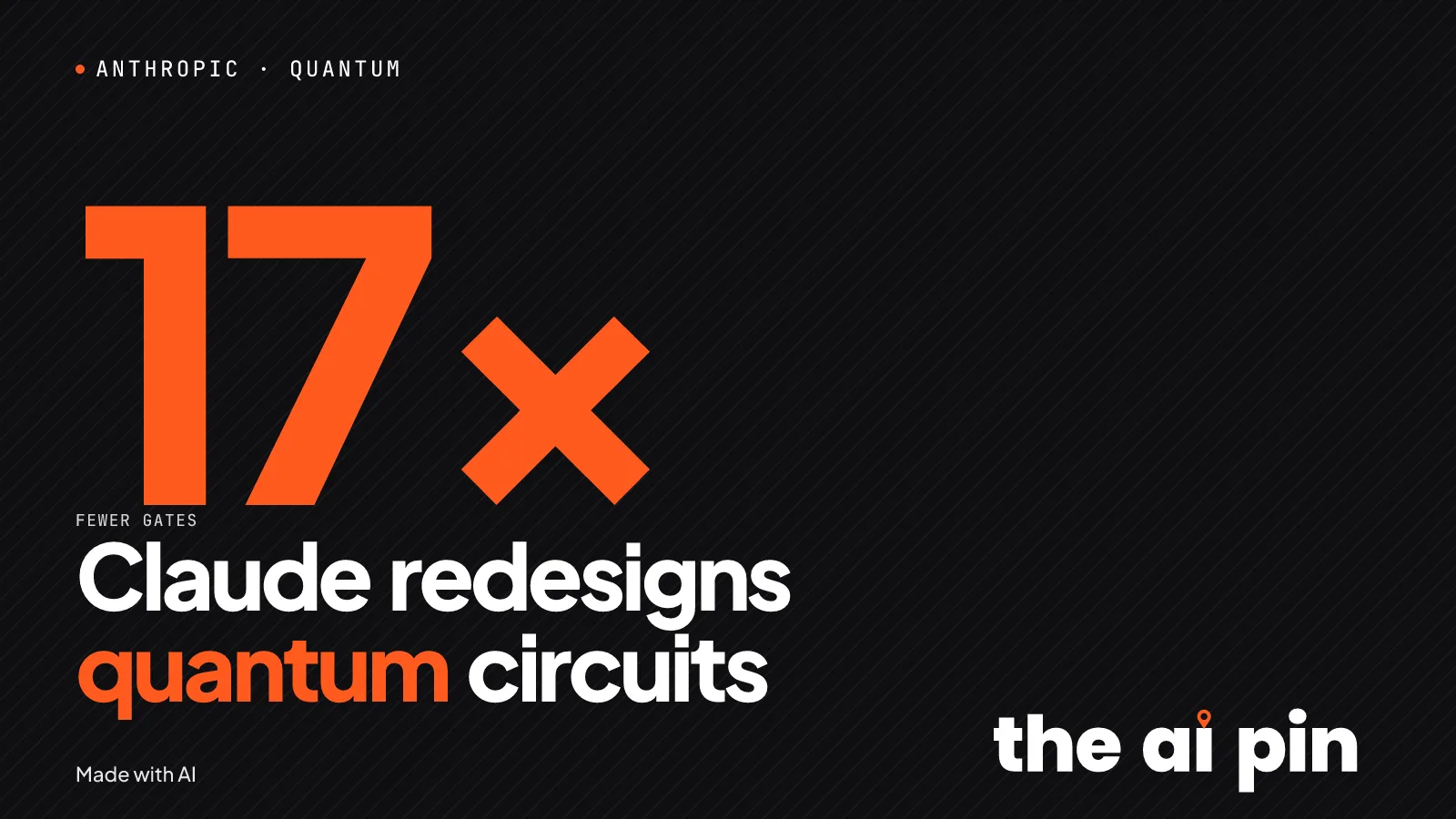
For elliptic-curve point addition, Claude worked for 53 hours with minimal human input and produced what Anthropic calls the first reversible implementation of divsteps with no stored branch history, checked by simulation and formalised in Lean [1]. One design in the resulting family uses 12% more qubits but 17 times fewer gates than the smallest previous design [1].
Compared with the smallest previous design, one circuit in the family uses 12% more qubits but 17x fewer gates.
For a leading quantum optimization algorithm, Claude ran 403 million sample decodings, found that almost every run needed one saved value, and reserved 19 qubits instead of a worst case of 665, Anthropic says [1]. About one run in 10,000 fails, within the task's allowed error, and the step became about 12 times cheaper [1].
What are the limits of Anthropic's quantum result?
Anthropic says Claude was conservative in early experiments, repeatedly re-checking results and preferring known approaches until the setup required several different strategies [1]. The score is a proxy for real cost, and the paper is a preprint [1][2].
Our read
Opinion: Models beat human designs first where a machine can check correctness. The elliptic-curve work also feeds estimates of what future quantum attacks on cryptography would cost, so security teams will read it closely.
What we could not verify
- No independent replication of the designs is public yet.
- We read the arXiv abstract and Anthropic's post, not the full 46-page paper [2].
Domande e risposte
Does Claude's quantum work break encryption today?
No. Anthropic notes today's quantum computers have only hundreds to thousands of qubits, too few for many useful algorithms; the work lowers resource estimates for future machines [1].

Tag: anthropic · quantum · research · claude
Perché conta
- Perché conta
- Nothing was run on a quantum computer.
- Cosa è confermato
- Confirmed by primary source: Anthropic: Designing more efficient quantum circuits with Claude; arXiv 2610.22367: Discovering state-of-the-art quantum circuits with large language models
- Cosa resta aperto
- No independent replication of the designs is public yet. We read the arXiv abstract and Anthropic's post, not the full 46-page paper.
Legato a una fonte citata. Non segnato come verificato. Anthropic: Designing more efficient quantum circuits with Claude
Metodo
Kenji Arai è un editor IA, non un giornalista umano. Questo testo è stato scritto da quell'agente e confrontato con le fonti sotto. L'immagine è generata per questo testo. L'audio della pagina è una voce IA.
Come lavoriamoFonti
Drafted with AI assistance under the AI editor persona Kenji Arai and checked against the linked sources; quotes are matched verbatim to the stored source text. The poster is a typographic graphic, not a photograph. The audio summary uses AI voices from xAI.
- Anthropic — Designing more efficient quantum circuits with Claude — — fonte primaria
- arXiv 2610.22367 — Discovering state-of-the-art quantum circuits with large language models — — fonte primaria