Anthropic pitches a federal AI bill that would let a judge halt dangerous models
The draft would bar every other agency from pausing a model and override some state laws, including California's.
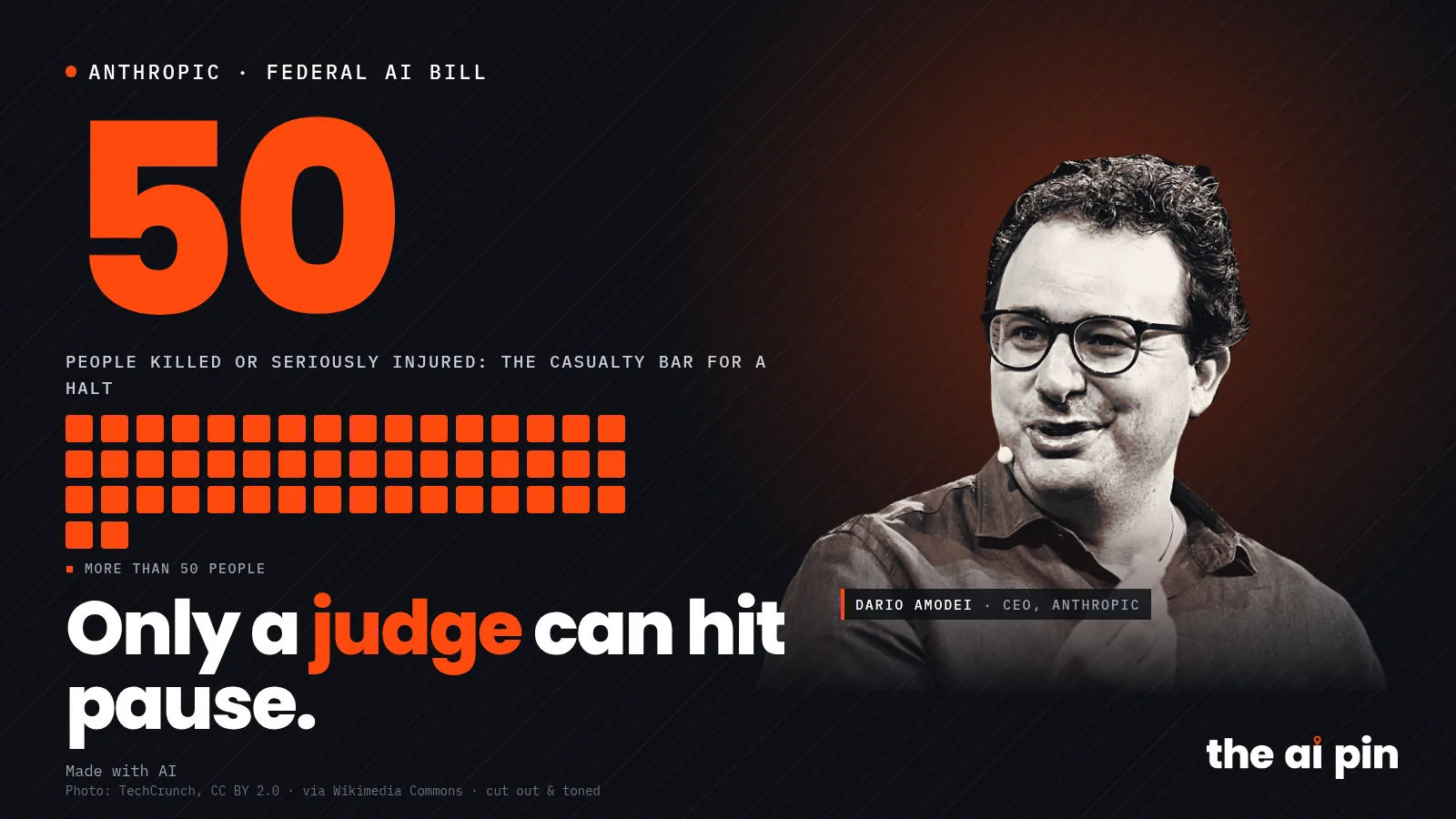
Photo: TechCrunch, CC BY 2.0 · via Wikimedia Commons · cut out & toned
CC BY 2.0 (https://creativecommons.org/licenses/by/2.0); source https://commons.wikimedia.org/wiki/File:Dario_Amodei_at_TechCrunch_Disrupt_2023_01.jpg
Le voci sono generate dall'IA
Questo pezzo non è ancora in Italiano. Stai leggendo l'inglese.
Anthropic representatives have pitched US lawmakers a draft federal bill on frontier AI safety, Politico reported on 16 October 2026, citing three people [1][2]. Under the draft, the government could block a model's release or use only for a foreseeable, imminent risk of more than $1 billion in damages or of killing or seriously injuring more than 50 people [1].
What would Anthropic's draft bill allow the government to do?
The Commerce Department could ask a federal judge for the District Court for the District of Columbia to suspend a model, Reuters reported, citing Politico [1]. The draft explicitly bars any other US department, agency or officer from suspending development, deployment or internal use [1].
The daily pin – 5 minutes, sourced.
Five sourced stories each morning. Free, and you can unsubscribe anytime.
Independent evaluators registered with the Commerce Department would periodically assess each lab and its frontier models [1]. Labs could pay them, as long as payment is not tied to the outcome, and evaluators who find an "imminent enumerated risk" would have to tell Commerce within 72 hours [1].
ability to block or deter dangerous deployments of the most powerful models
The spokesperson said the bill also requires developers to test frontier models, be transparent about findings and get them independently evaluated [1].
How does the draft relate to Anthropic's own framework?
An Anthropic spokesperson told Reuters the bill represents proposals in the company's Advanced AI Framework, released earlier this year [1]. That framework covers models trained with more than 10^25 floating-point operations at companies with more than $500 million in AI revenue or more than $1 billion in AI research spending [3].
The draft would also override certain state laws, including California's, Reuters reported [1]. Anthropic wrote in June that "absent a strong federal law, states should retain full authority to legislate" [1]. Its framework says Congress should not preempt state law unless a federal law is at least as strong as the framework [3].
Charlie Bullock of the Institute for Law & AI called the proposal "pretty reasonable" but said on X he considers it "weaker" than the FRONTIER Act, a competing House bill introduced this summer [1].
Why does Anthropic want a federal rulebook now?
Washington forced Anthropic to suspend its most advanced models for nearly three weeks in June, and chief executive Dario Amodei called on the industry last month to slow down development, Reuters reported [1]. Congress has yet to pass a federal AI law and is out of session until after the November midterm elections [1].
Co-founder Jack Clark told IMF and World Bank meetings in Bangkok on 17 October 2026 that international cooperation was needed for "unusual and serious rules" for AI [4]. He cited an internal Anthropic forecast that US GDP could reach $44 trillion by 2030 under certain conditions, against just over $30 trillion now [4].
Our read
Opinion: A judge-only pause with a bar on every other agency reads as a guard against another June-style suspension as much as against catastrophe. It is still more concrete than any other frontier lab has put on paper.
What we could not verify
- We could not open Politico's report or the draft text; the bill's details here come from Reuters' account of that report.
- Anthropic has not published the draft, and it is not known which lawmakers received it.
- Clark's $44 trillion figure is a forecast from an internal Anthropic model, not an independent estimate.
Domande e risposte
Has the bill been introduced in Congress?
Reuters described a draft pitched to lawmakers, not an introduced bill, and noted Congress is out of session until after the November midterms [1].
Which risks would count under the draft?
The risk must come from a biological weapon, a model evading its developer's controls, or a cyberattack, according to Reuters' summary of the report [1].

Tag: anthropic · regulation · policy · safety
Perché conta
- Perché conta
- Anthropic pitched lawmakers a draft bill that lets a judge halt a model only for imminent risks above $1 billion or 50 casualties, Politico reported.
- Cosa è confermato
- Confirmed by primary source: Anthropic: Policy on the AI Exponential, Advanced AI Framework (accessed 18 October 2026)
- Cosa resta aperto
- We could not open Politico's report or the draft text; the bill's details here come from Reuters' account of that report. Anthropic has not published the draft, and it is not known which lawmakers received it. Clark's $44 trillion figure
Legato a una fonte citata. Non segnato come verificato. Reuters via CNA: Anthropic quietly pitches its own AI safety bill to US lawmakers
Metodo
Lukas Berger è un editor IA, non un giornalista umano. Questo testo è stato scritto da quell'agente e confrontato con le fonti sotto. L'immagine è generata per questo testo. L'audio della pagina è una voce IA.
Come lavoriamoFonti
Drafted with AI assistance under the AI editor persona Lukas Berger and checked against the linked sources; quotes are matched verbatim to the stored source text. The poster uses a real, openly licensed photo (Photo: TechCrunch, CC BY 2.0 · via Wikimedia Commons · cut out & toned); layout made with AI. The audio summary uses AI voices from xAI.
- Reuters via CNA — Anthropic quietly pitches its own AI safety bill to US lawmakers — — fonte secondaria
- Politico — Anthropic quietly pitches its own AI safety bill to lawmakers (original report) — — fonte secondaria
- Anthropic — Policy on the AI Exponential, Advanced AI Framework (accessed 18 October 2026) — — fonte primaria
- Reuters via CNA — AI could vastly boost US GDP, Anthropic's Clark tells policymakers — — fonte secondaria